About the Environmental Section
The Environmental Section provides advice and representation to several agencies, including primarily the Department of Environmental Conservation, assisting them in the performance of their duties related to environmental matters.
Scope of Work
Oil Spill Prevention and Response
The section advises and defends DEC regarding oil spill contingency plan approvals. When spills occur, the section provides investigative, enforcement, and litigation services to ensure that the response is prompt and complete, that state costs and damages are reimbursed, and that violations of law are assigned fair consequences. Advice is also provided with respect to the prevention and amelioration of fuel oil spills from above and underground storage tanks.
Contaminated Sites
The Section advises the Division of Spill Prevention and Response on cleanup of contaminated sites in the state, including on current or formerly used federal land. In consultation with DEC, section attorneys pursue appropriate enforcement actions to ensure cleanup at contaminated sites or recommend to DEC that the state initiate a state led cleanup. In either case, the section pursues reimbursement of any state cleanup expenditures. The section consults with DEC in decisions to release a potentially responsible party from liability when available evidence indicates that the party is not, in fact, liable under state law. Section attorneys work with DEC to negotiate prospective purchaser agreements for contaminated sites when appropriate. The Section's representation includes instances where the state is seeking to enforce cleanup or secure cost recovery as well as in those cases where the state is sued with respect to its role in a contaminated site or in carrying out its regulatory function.
Air and Water Quality
The Section provides legal advice to the Division of Air Quality regarding the issuance and defense of air permits and provides legal representation for enforcement of clean air laws and regulations. The Section also provides advice to the Division of Water on water quality issues including permitting for large mines, NPDES primacy, marine vessel wastewater discharges, domestic wastewater, and drinking water. Advice is also provided to the Village Safe Water program on a variety of issues related to that program.
Public Health
The Section provides legal advice to DEC's Division of Environmental Health on public health issues, such as food safety, solid waste, drinking water, animal health, and pesticides.
Homeland Security
Legal advice is provided to various state officials regarding efforts to improve security of critical facilities, such as the Trans Alaska Pipeline and drinking water supplies.
Legal Defense of State Actions
The Section defends state agencies and officials when they are sued for the performance of their duties. These include cleanup decisions, issuance of permits, approval of contingency plans, and other matters.
Significant Environmental Matters
North Pole Refinery Groundwater Contamination
An industrial chemical, sulfolane, was discovered in drinking water wells near the North Pole Refinery in 2009. Since then, a major site investigation and response has been underway. Affected residents were provided with alternative drinking water supplies or treatment systems to remove the sulfolane from their drinking water. The sulfolane plume is in the groundwater to the north and west of the refinery. The plume is approximately 2 miles wide, 3 ½ miles long, and has been measured at over 300 feet beneath the surface. Sulfolane has been detected in approximately 350 wells in the area. Sulfolane is an emerging contaminant, and the long-term health effects of exposure are still being studied.
The department has been assisting DEC at each step in the cleanup process, as DEC directs the work on various contaminants of concern, including sulfolane. In March 2014, the State filed a case against Williams Alaska Petroleum, Inc. and Flint Hills Resources Alaska, LLC, the former refinery owners and operators, seeking cost recovery, natural resource damages, and declaratory and injunctive relief. The City of North Pole also sued. The State and the City of North Pole settled with Flint Hills, entering an agreement to expand the City’s piped water system to all improved properties located within the sulfolane plume or in its anticipated migration path. The case against Williams proceeded to trial, and involved not only the sulfolane pollution, but also Williams’ legacy of petroleum spills and releases of perfluoroalkyl substances (aqueous film-forming foams used in fire suppression). The State won its case against Williams at the superior court. After Williams appealed, the Alaska Supreme Court affirmed on almost all grounds, remanding only for revisions to the superior court’s order for injunctive relief. Proceedings on that limited remand are ongoing.
Water and Wetlands Permitting Issues
The State of Alaska has over 174 million acres of wetlands, nearly 900,000 miles of navigable rivers and streams, 22,000 square miles of lakes, and more coastline than the Lower 48 combined. Accordingly, Alaska has a strong interest in federal water policy. The Environmental Section is heavily involved in protecting Alaska’s right to manage its own water and lands.
The Section is presently engaged in efforts to narrow the definition of Waters of the United States, which defines the scope of jurisdiction of EPA and the Army Corps over waters within state boundaries. The State, through the Section, participates in EPA rulemaking and other efforts. We have coordinated comments in opposition to the Biden Administration’s expansive definition of WOTUS, and hosted a regional roundtable with EPA and Corps officials and representatives from industry, environmental conservation groups, and state officials. At the Supreme Court level, we filed an amicus brief in Sackett v. EPA urging a narrower construction of the definition of Waters of the United States.
The Section has also coordinated comments on behalf of Alaska opposing EPA’s exercise of its power under section 404(c) of the Clean Water Act, which, if finalized, would close down 309 square miles of Alaska-owned land from development. The Section coordinated a response to the proposed rulemaking on behalf of all of Alaska’s affected state agencies, including the Department of Environmental Conservation.
Exxon Valdez Oil Spill
Through settlement of litigation related to the Exxon Valdez oil spill the State of Alaska and the Federal Government received a $900 million civil settlement. A Trustee Council was formed to oversee restoration of the injured ecosystem through the use that settlement, and that Council continues today. The Council consists of three state and three federal trustees and is advised by members of the public and by members of the scientific community. Work funded by the Council includes research addressing a broad variety of subject matter used by the public such as evaluating wildlife recovery, monitoring ecosystem health, and mapping lingering oil. The Council has also funded various habitat enhancement and protection projects by restoring and revitalizing habitats and improving access. For more information, please visit the Exxon Valdez Oil Spill Trustee Council web site.
Selendang Ayu Grounding and Oil Spill
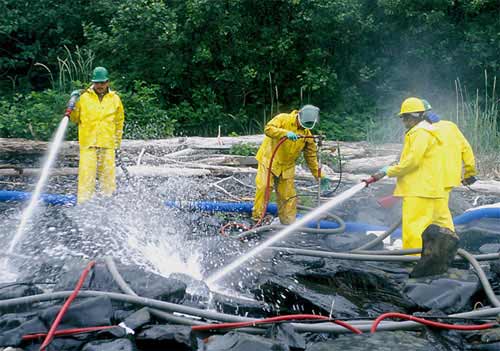
On December 8, 2004, the 738-foot cargo vessel M/V Selendang Ayu, ran aground and broke in half off Unalaska Island in the Aleutian Islands. The cargo vessel, which was bound for Asia with a 60,000-ton soybean load, was carrying approximately 425,000 gallons of Intermediate Fuel Oil 380 and 21,000 gallons of marine diesel oil; an estimated 354,218 gallons of those oils were released into the environment. Six of the vessel's crew members were lost in the rescue effort. Representatives of natural resources trustee agencies, which for the State include the Departments of Law, Natural Resources, Environmental Conservation, and Fish and Game, undertook pre assessment activities associated with the natural resource damage assessment and restoration process. The Trustees are currently evaluating restoration opportunities.
The United States Fish & Wildlife Service is the federal lead administrative trustee agency and maintains a web site with information on the natural resource damage assessment process.
The Department of Law, on behalf of the Departments of Environmental Conservation, Natural Resources and others, asserted civil claims against the owner and operator of the M/V Selendang Ayu arising out of the grounding and oil spill. The State recovered oil spill penalties, wreck removal, trespass and other non-
natural resource damages. Included in these civil claims was recovery of the State's costs responding to and overseeing the response to oil spill from the Selendang Ayu and the company's wreck removal efforts.
Appeal of the Donlin § 401 Clean Water Act Certification
Donlin Gold, LLC is proposing to develop an open-pit mining operation in southwest Alaska within the Crooked Creek Watershed. In 2018, DEC issued a Clean Water Act § 401 Certificate which asserts that there is reasonable assurance that the project will comply with state water quality standards. The Certificate has been challenged multiple times since its issuance in 2018. The Orutsararmiut Native Council (“ONC”) filed two informal review requests for the Certificate per 18 AAC 15. In response, the Division of Water amended its response to comments and reissued the Certificate twice. ONC then requested an adjudicatory hearing that granted on three issues: water temperature, mercury, and existing uses. After a hearing on the briefs, the Commissioner determined there was reasonable assurance the Donlin project would not exceed Alaska water quality standards and maintained the certificate. ONC then submitted a Notice of Appeal to the Superior Court of the State of Alaska for the Commissioner’s decision to uphold the certificate; the Superior Court granted an interlocutory remand back to the Division of Water for DEC to consider two newly filed expert reports on the issues of mercury and temperature. DEC determined that the two reports provided even greater assurance that the project would not violate the water quality standards. ONC requested an adjudicatory hearing on the issue of temperature. The issue has been briefed and we are awaiting a Commissioner decision.
Particulate Matter 2.5 (PM 2.5)
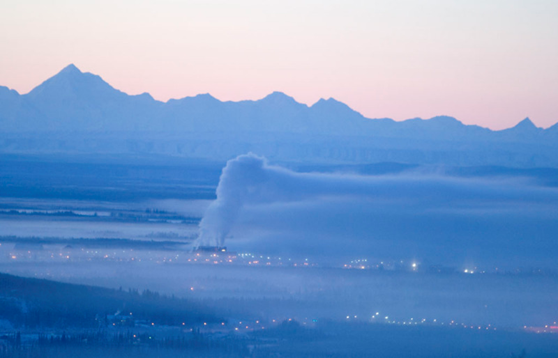
During the winter, temperatures in subarctic cities commonly drop to greater than 40 degrees below zero. In the greater Fairbanks and North Pole area, a natural inversion phenomenon traps cold air below a warmer boundary layer that is extremely close to the ground. Particulate air pollution from combustion activities (from motor vehicles, power plants, wood burning, and more) accumulate and cannot dissipate until the inversion ceases.
Particulate air pollution includes a complex mixture of both solid particles and liquid droplets found in the air. These particles come in different sizes and shapes. Particles less than 2.5 micrometers (PM2.5) in size, also known as “fine particulate matter,” can lodge deeply into lungs, enter the bloodstream, and cause numerous cardiac and respiratory health problems.
Fine particulate matter is regulated under the Clean Air Act. Because concentrations exceed regulatory levels for ambient air quality in the greater Fairbanks and North Pole area, the State of Alaska is required to develop meaningful controls for reducing these harmful concentrations.
The Department of Law aids the Department of Environmental Conservation with all legal issues related to air pollution in the greater Fairbanks and North Pole area. These include developing air quality plans required by the Clean Air Act, enforcing regulations that apply to industrial energy sources and wood heaters, and assisting with long-range planning for future approaches to air pollution.
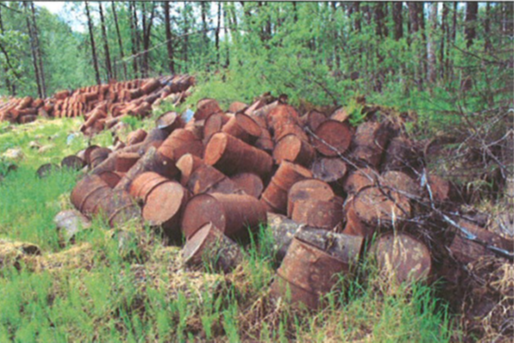
Forcing the Federal Government to Clean Up Contaminated Lands Transferred under ANCSA
In 1971, Congress enacted the Alaska Native Claims Settlement Act (“ANCSA”) to create a “fair and just settlement of all claims by Natives and Native groups of Alaska, based on aboriginal land claims[.]” 43 U.S.C. § 1601(a). Through ANCSA, the United States sought to extinguish all Alaska Natives’ claims to aboriginal title to over 360 million acres of land in Alaska, in exchange for title to a designated 44 million acres of land (“ANCSA Lands”) and other compensation.
When Alaska Natives agreed to relinquish their aboriginal land rights, neither Alaska Native people nor Alaska residents expected that these lands would be contaminated. Significant portions of over one thousand parcels (that make up over 17.6 million acres of the ANCSA Lands), given by the United States as consideration for the Alaska Natives’ rights taken, were contaminated with hazardous substances.
On July 15, 2022 the Alaska Department of Environmental Conservation filed suit against the United States Department of Interior and the Bureau of Land Management to compel the United States to evaluate the extent of the contamination and create a plan to clean up contaminated sites on ANCSA Lands. Congress instructed the BLM to prepared a detailed cleanup plan on how it intended to clean up contaminated sites. On July 18, 2023, the Federal District Court of Alaska dismissed the State’s claim, holding that the State could not demonstrate an injury caused by the Department of Interior. The State is evaluating an appeal to the Ninth Circuit.
The Department of Law, with the aid of outside counsel, will continue to marshal this case while continuing to work with the Department of Environmental Conservation and Alaska Natives to clean up contaminated sites.
Safe Drinking Water
The Environmental Section of the Alaska Department of Law works to protect the public’s access to clean drinking water, both in their homes and underground. We have won cases against operators of public water systems, such as landlords who fail to provide their residents with running water, operators who fail to sample the drinking water they supply for dangerous contamination, and property owners who endanger underground drinking water aquifers through their negligence. Together with the Alaska Department of Environmental Conservation, we work to ensure that the public can trust what comes out of their taps to be safe and reliable.Alaska Joint Assessment Team (JAT)
The goal of the Alaska JAT is to facilitate Natural Resource Damage Assessment (NRDA) and restoration planning in Alaska among NRDA practitioners. The JAT consists of Natural Resource Trustees, both State and federal, as well as industry representatives. The Department of Law is a natural resource Trustee in Alaska. In the near-term, the Alaska JAT will concentrate on NRDA and restoration planning for oil spills in the Arctic. The JAT is working to enhance the effectiveness and efficiency of NRDA following a potential spill through the development of tools and products; thereby increasing the likelihood of successful cooperative assessments and restoration in the event of an oil spill. For more information about NRDA, please visit NOAA's Damage Assessment, Remediation, & Restoration Program (DARP).
Section Contact
For further information on Environmental Law contact:
Jennifer Currie
Chief Assistant Attorney General, Section Supervisor
907-269-5232